
Nizo Yamamoto: Master of Anime Scenography
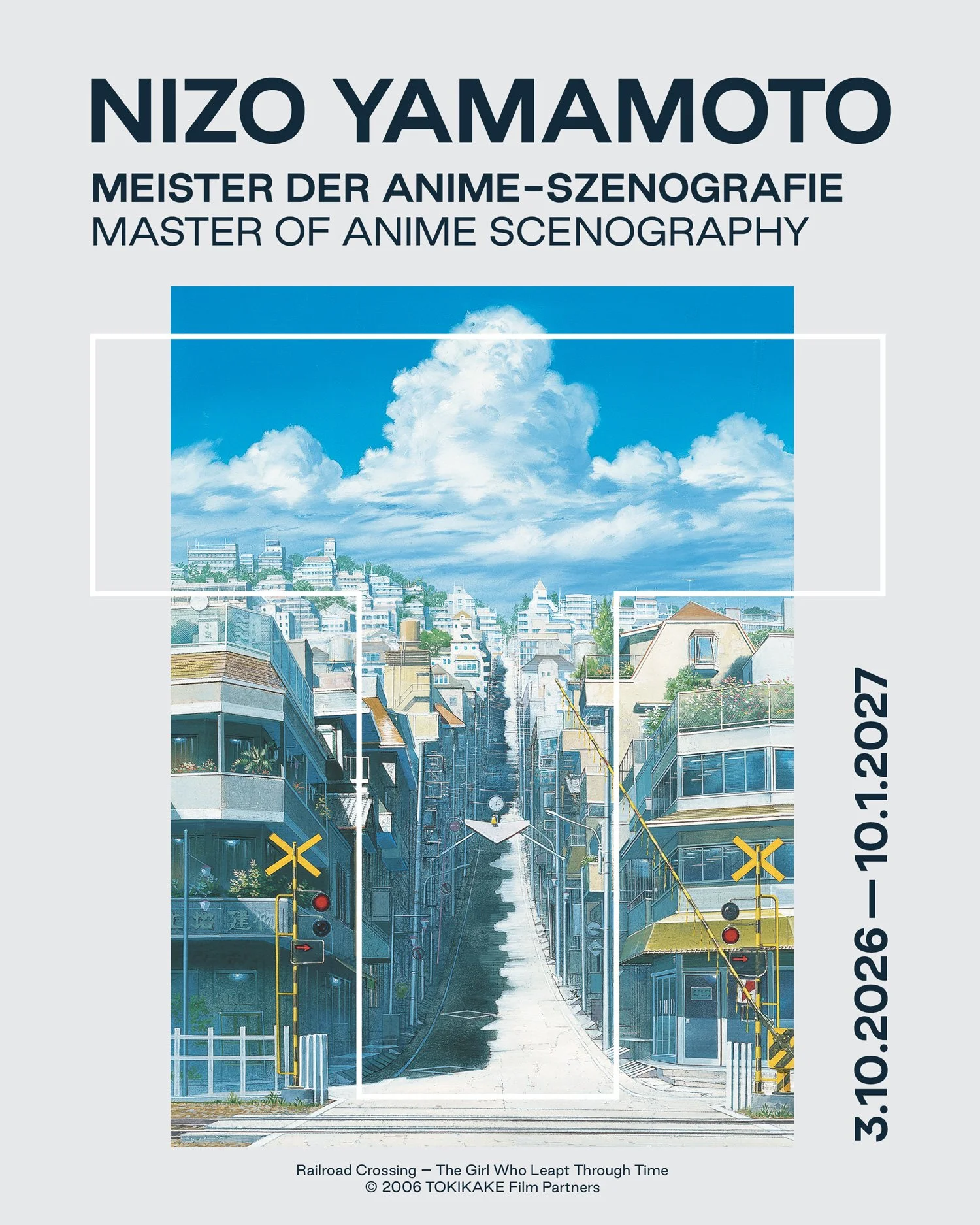
From October 3, 2026 to January 10, 2027, the S. Tchoban Foundation. Museum for Architectural Drawing, Berlin, presents Nizo Yamamoto: Master of Anime Scenography, the first comprehensive exhibition outside Japan dedicated to the artistic work of Nizō Yamamoto (1953–2023), one of the most influential art directors in Japanese animated film. For more than four decades, Yamamoto created visual worlds that have left a lasting mark on the visual memory of the genre.
In Japan, Yamamoto's work has long enjoyed great recognition. Internationally, however, his name remains far less known than the films in whose creation he played a key role. Through his work on Castle in the Sky (1986), Grave of the Fireflies (1988), Princess Mononoke (1997), and The Girl Who Leapt Through Time (2006), his imagery is familiar to audiences worldwide.
Curated by Stefan Riekeles (Riekeles Gallery), the exhibition presents around 120 original works and builds on the museum's earlier exhibitions on background art in Japanese animated film: in 2016, Anime Architecture showcased the urban spaces of major science-fiction anime such as Patlabor (1989), Ghost in the Shell (1995), and Ghost in the Shell 2 – Innocence (2004); in 2022, AKIRA – The Architecture of Neo Tokyo presented the original background art from the groundbreaking film AKIRA (1988) for the first time worldwide.
S. Tchoban Foundation. Museum for Architectural Drawing, Christinenstraße 18a, 10119 Berlin · October 3, 2026 – January 10, 2027.
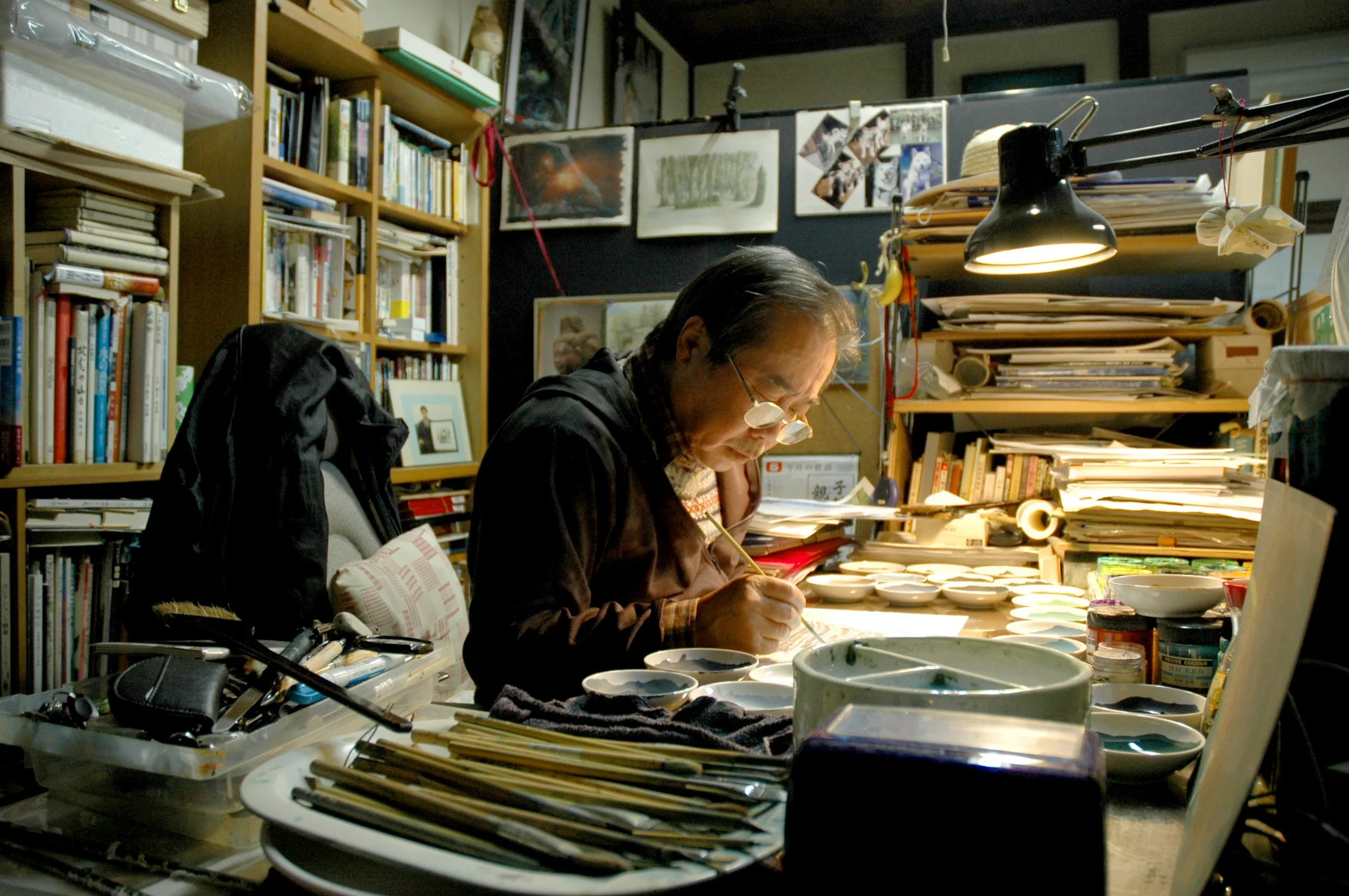
Nizo Yamamoto (1953 - 2023) in his studio.
Nizo Yamamoto's Art for Animation
Background paintings for animated film are not autonomous works; they provide spatial orientation, convey atmosphere and support the action. They must not compete with the story but serve it, and they succeed precisely when they do not draw attention to themselves. That may be one reason why the beauty of these works went largely unnoticed by a wider public for so long.
The production of animation backgrounds relies on a division of labour. The process begins with image boards, which set out the mood, lighting and colour harmonies of a film's world; it continues through art settings and through layout drawings, which fix the camera position, framing and spatial arrangement of every shot; and it ends with the finished backgrounds. Individual sheets are therefore usually the outcome of a chain of collective decisions. Yamamoto's work is an exception. He carried out many of these steps himself, from the image boards through to the production backgrounds, and can, therefore, in many cases, genuinely be called the author of his works.
He described his aim in these terms: "I want to paint soft images that the viewer's eye does not bounce off. Rather than a forceful image that seems to leap out at the viewer, I want to draw the eye naturally into the depth of the image and lead it into the world of the film."
About the Artist
Nizo Yamamoto was born on 27 June 1953 in Goto, Nagasaki Prefecture, and grew up on the island of Fukue. At the age of ten, he saw the animated film The Little Prince and the Eight-Headed Dragon (1963) in his school gymnasium and thought: "So such beautiful worlds exist!" By nineteen, he had moved to Tokyo, enrolled at a vocational school for animation and taken a job at a background art studio at the same time, where he met his future wife, Chieko.
In 1978, his teacher Kazue Ito recommended him to Hayao Miyazaki, who had lost the art director for Future Boy Conan. At twenty-four, Yamamoto took charge of the series, and the many skies he painted for it became his training ground.
Chie the Brat: Downtown Story followed in 1981 as his first feature film as art director, and three years later he was art director on the episodes of Sherlock Hound directed by Miyazaki.
In 1986, he was art director of Castle in the Sky, the first film produced by Studio Ghibli. Two years later came Grave of the Fireflies, the film that left the deepest impression on him.
In 1990, he founded his own studio, which he renamed Kaieisha two years later. A slump in the mid-nineties left him no longer wanting to draw, and he decided to overcome it by taking on an even more demanding project: two years of work on Princess Mononoke (1997), where he designed the Forest of the Deer God.
In 2006, as art director of Mamoru Hosoda's The Girl Who Leapt Through Time, he gave the summer clouds the form that has been known as "Nizo clouds" ever since. His first major solo exhibition, in Kobe in 2011, drew 85,000 visitors; as a touring exhibition, it reached more than a million people at forty-five venues. A museum dedicated to his work opened in Goto in 2018. Nizo Yamamoto died in August 2023, at the age of seventy, in his studio.
The Book

Title: Nizō Yamamoto: Art for Animation
Editor: Stefan Riekeles
Language: English
Publisher: Riekeles Gallery
Design: Annika Paetsch
Publication date: October 2026
ISBN: 978-3-00-087124-5
Format: 24 × 28 cm, landscape format
Binding: Hardcover with yellow cloth spine and printed cover boards
Pages: 182
Illustrations: background paintings, image boards, layouts, production materials
Edition: First edition
Shipping starts: October 2026
This is a pre-order item. Orders will be shipped from the end of November 2026.
Payment is collected when the order is placed. Orders containing this book will ship once the book is available.
Plus shipping costs. Shipping costs are calculated at checkout.
We’re shipping world-wide from Potsdam, Germany by UPS and DHL Express.
Description
Nizō Yamamoto (1953–2023) was one of the defining art directors in Japanese animation and a pioneering figure in the development of anime background art. Over a career spanning more than four decades, he shaped the visual worlds of some of the medium’s most celebrated works, collaborating with directors such as Isao Takahata, Hayao Miyazaki, and Mamoru Hosoda. In Japan, his achievements have long been held in the highest regard, yet internationally his name remains far less familiar than the landmark projects he helped to create. Through Future Boy Conan, Castle in the Sky, Grave of the Fireflies, Princess Mononoke, The Girl Who Leapt Through Time, and more, his images are cherished by anime fans around the world. As the first English-language book dedicated to Yamamoto’s art, this volume brings together background paintings, image boards, and rare production materials. It traces the development of his visual language and reveals how his extraordinary command of light, atmosphere, and space transformed background art into one of the central expressive forces of Japanese animation.
Featuring background art and production materials from (among others):
Future Boy Conan
Castle in the Sky
Grave of the Fireflies
Princess Mononoke
The Girl Who Leapt Through Time
Weathering With You
Including a glossary, selected filmography, and bibliography.
Includes a spectacular gatefold featuring a 1:1 reproduction of background art from Princess Mononoke, unfolding to an impressive 160 cm in width.
Cover and specifications may be subject to minor changes before publication.
As the first English-language book dedicated to Yamamoto's art, Nizō Yamamoto: Art for Animation (edited by Stefan Riekeles, design by Annika Paetsch, Riekeles Gallery) brings together background paintings, image boards, and rare production materials from Future Boy Conan, Castle in the Sky, Grave of the Fireflies, Princess Mononoke, The Girl Who Leapt Through Time, Weathering With You and more, tracing the development of his visual language. The book includes a glossary, selected filmography and bibliography, as well as a gatefold with a 1:1 reproduction of background art from Princess Mononoke, unfolding to 160 cm in width.
Hardcover, 24 × 28 cm landscape format, 182 pages. Publication date: October 2026.
An exhibition by the S. Tchoban Foundation. Museum for Architectural Drawing.
Director: Nadja Bartels.
Curated by Stefan Riekeles, in cooperation with Riekeles Gallery, Potsdam, Kaieisha, and Kobe Shimbun.
Lender: Estate of Nizō Yamamoto, Takao Yamamoto.
Exhibition design and graphic design: Annika Paetsch.