
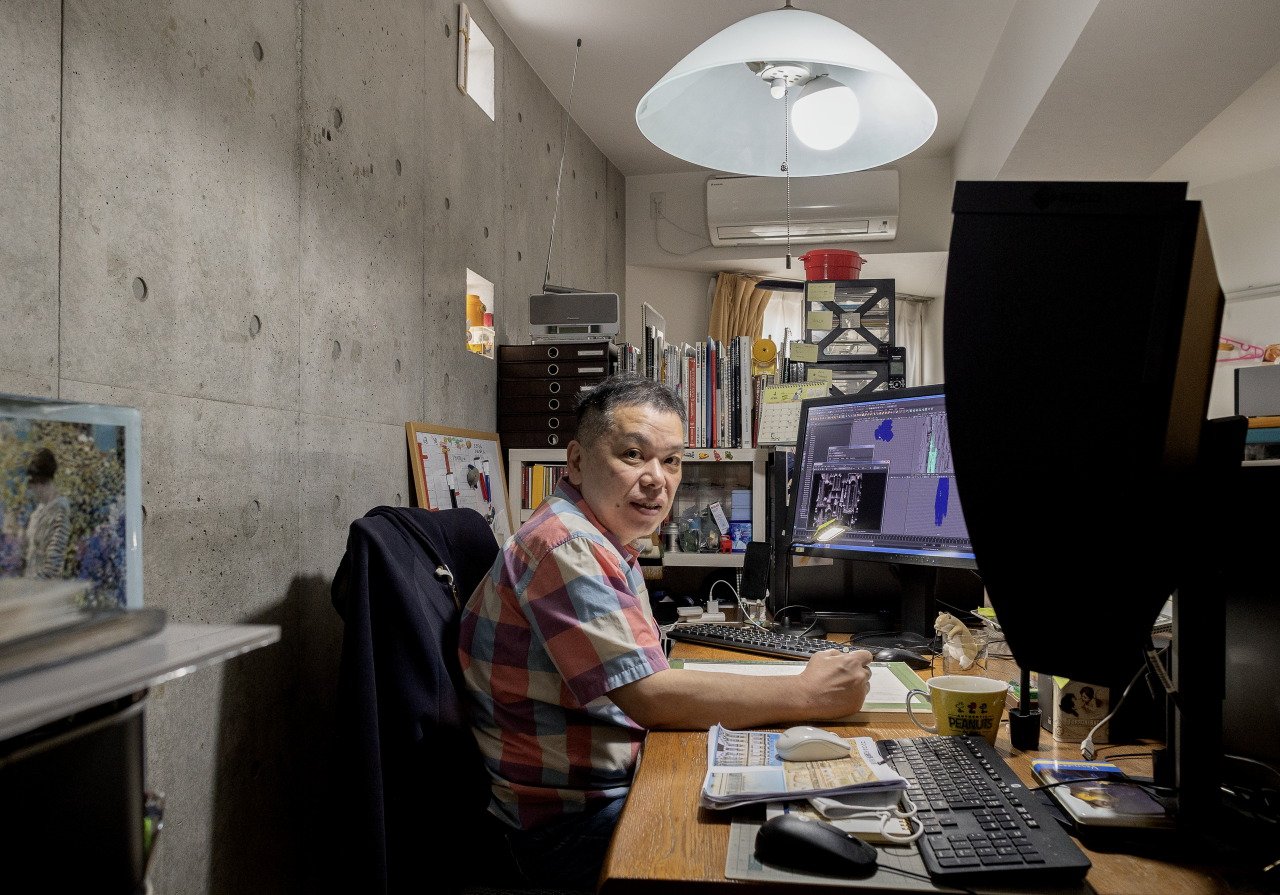
Shūichi Kusamori
Shūichi Kusamori (草森秀一), born in 1961 in Kanagawa Prefecture, is an art director.
In many productions he is credited as Shūichi Hirata (平田秀一).
After marriage he adopted the family name of his wife, Kusamori in 2012.
About Shūichi Kusamori
by Stefan Riekeles
Shūichi Kusamori (b. 1961 in Kanagawa) is one of Japan’s leading art directors in animation. For over forty years, his images have helped define what we now recognize as “anime.”
After graduating from Tokyo Designer Gakuin, he was involved early on in several films that are now considered classics of the genre: Grave of the Fireflies (1988), Patlabor: The Movie (1989), and GHOST IN THE SHELL (1995). As art director, he shaped the visual worlds of Metropolis (2001), Innocence (2004, Cannes Film Festival), xxxHOLiC: A Midsummer Night's Dream (2005, Annecy), and the internationally acclaimed PSYCHO-PASS series (2012–2023).
Over the years, Kusamori has developed a unique style and visual language that clearly sets him apart from many of his peers. In his work, he rarely depicts real urban or natural landscapes; instead, he creates imaginary worlds rendered with overwhelming realism.
As a curator and gallerist, my aim is to identify strong and individual artistic voices in the field of background painting. Kusamori is one of the artists who stand out most clearly. To understand the quality of his work, allow me to provide some background.
The production of an animated film is a highly collaborative process. Each step in the pipeline is prepared by a previous phase of development. Script, storyboard, imageboards, and layout are all necessary stages before a final background is painted and the characters are animated—usually by different artists. The painters responsible for the colored backgrounds, which form the film’s scenic environment, typically do not create the visual concepts or line drawings on which their paintings are based.
Only a few background artists invent the worlds they bring to life through color, light, and shadow. One of Shūichi Kusamori’s exceptional strengths lies precisely in this: he does not limit himself to executing predefined concepts, but instead develops original visions and worlds that give his films their unmistakable atmosphere. This creative agency elevates his work into a form of autonomous artistic expression.
The task of an art director in animation is also to develop a visual style for the entire film—one that a large team can apply. This style must be neither too demanding nor too simplistic, so that it can be consistently executed while still elevating the quality of the production. The art director defines this style and communicates it to the team, ensuring visual coherence across what may amount to a thousand or more backgrounds. What matters here is not specific colors, but the overall impression of a scene. Based on this shared visual goal, each artist is given a certain degree of freedom in how they contribute, using their own techniques to achieve it. In the era of hand-painted animation—before the advent of digital tools—these individual decisions were especially visible in the painterly texture of the work.
Alongside his visionary strength, Shūichi Kusamori has developed a distinctive visual sensibility and exceptional craftsmanship that allow him to meet the demands of each production. His extremely detailed drawings and paintings display an almost obsessive attention to detail that inevitably draws the viewer into his worlds. His unmistakable style runs through all his productions—and it is also evident in his personal works. This is why he is of particular interest to me as a curator.
Today, most steps in animation production are of course executed digitally. Kusamori belongs to a generation of artists who began their careers with pencil and brush, and only encountered digital tools relatively late. Over the past decades, he has shown great skill in both realms. However, he still prefers traditional materials. Especially when it comes to inventing new worlds, he continues to rely on analog tools. As he puts it, drawing on paper is more a process of discovery through action than the execution of a fully formed idea. Digital techniques, by contrast, tend to facilitate the realization of an already imagined image. As a visionary artist, he therefore feels more at home working with pencil and brush. This also makes him highly relevant for my gallery work, as I place great value on the craftsmanship behind each piece and prefer working with handmade originals over digital images.
Many of Kusamori’s concepts begin with a pencil drawing on paper. These drawings may be less flashy or eye-catching than his fully painted works, but to me, they are the true core of his art. It is in these sketches that his search for visionary expression and a personal visual language becomes most visible. When contemplating the thousands of pencil strokes, one gets the feeling of witnessing the artist immersing himself in his own worlds. Viewers can’t help but ask: How long did he work on this image? What kind of patience does it take to create hundreds of such pieces? In this way, Shūichi Kusamori’s passion for his work becomes something one can feel directly—without explanation.
Photos of Kusamori by Yasuyuki Takagi, 2023

Available artwork
At Riekeles Gallery we’re proud to offer original artwork, signed prints and poster editions of Kusamori’s iconic background artwork.


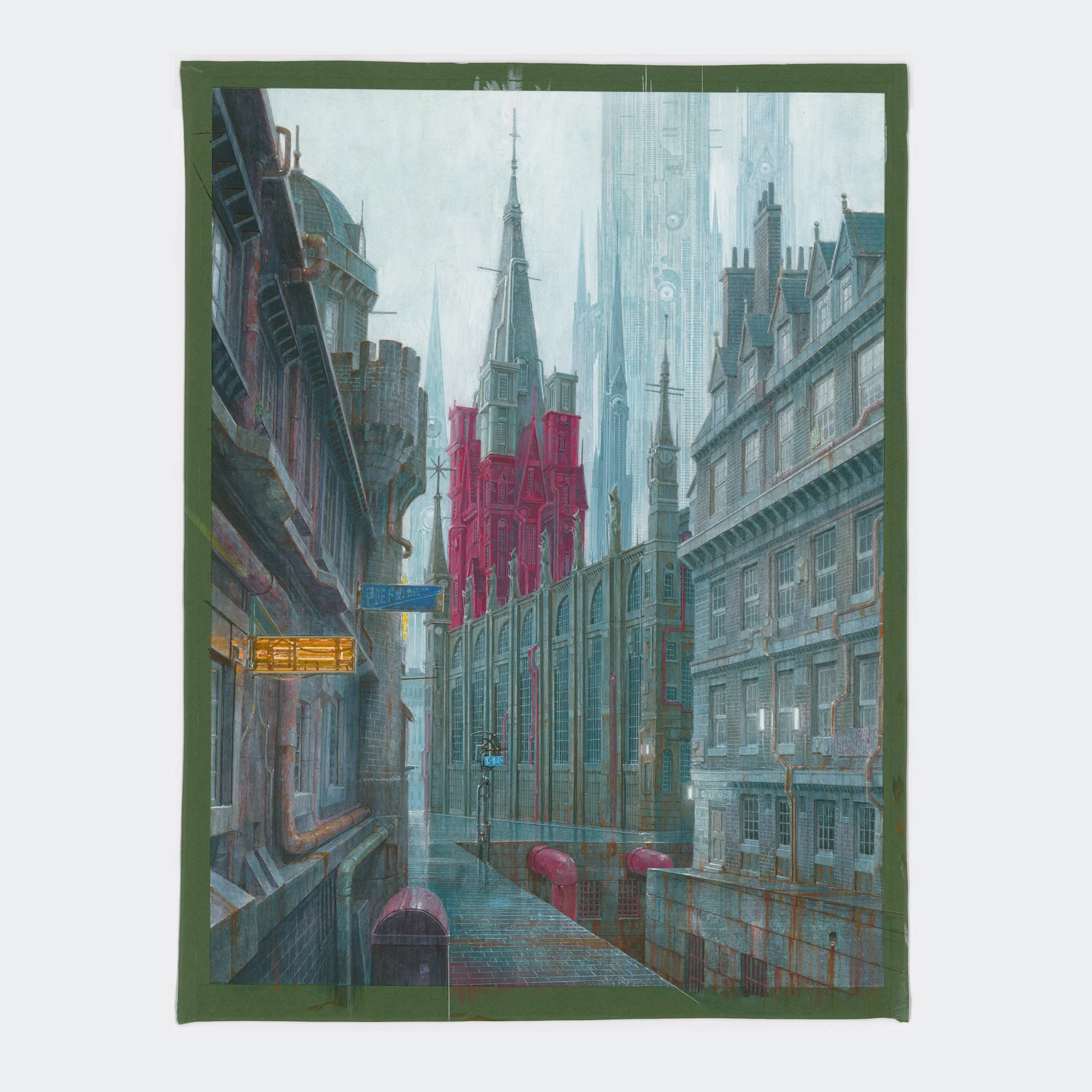
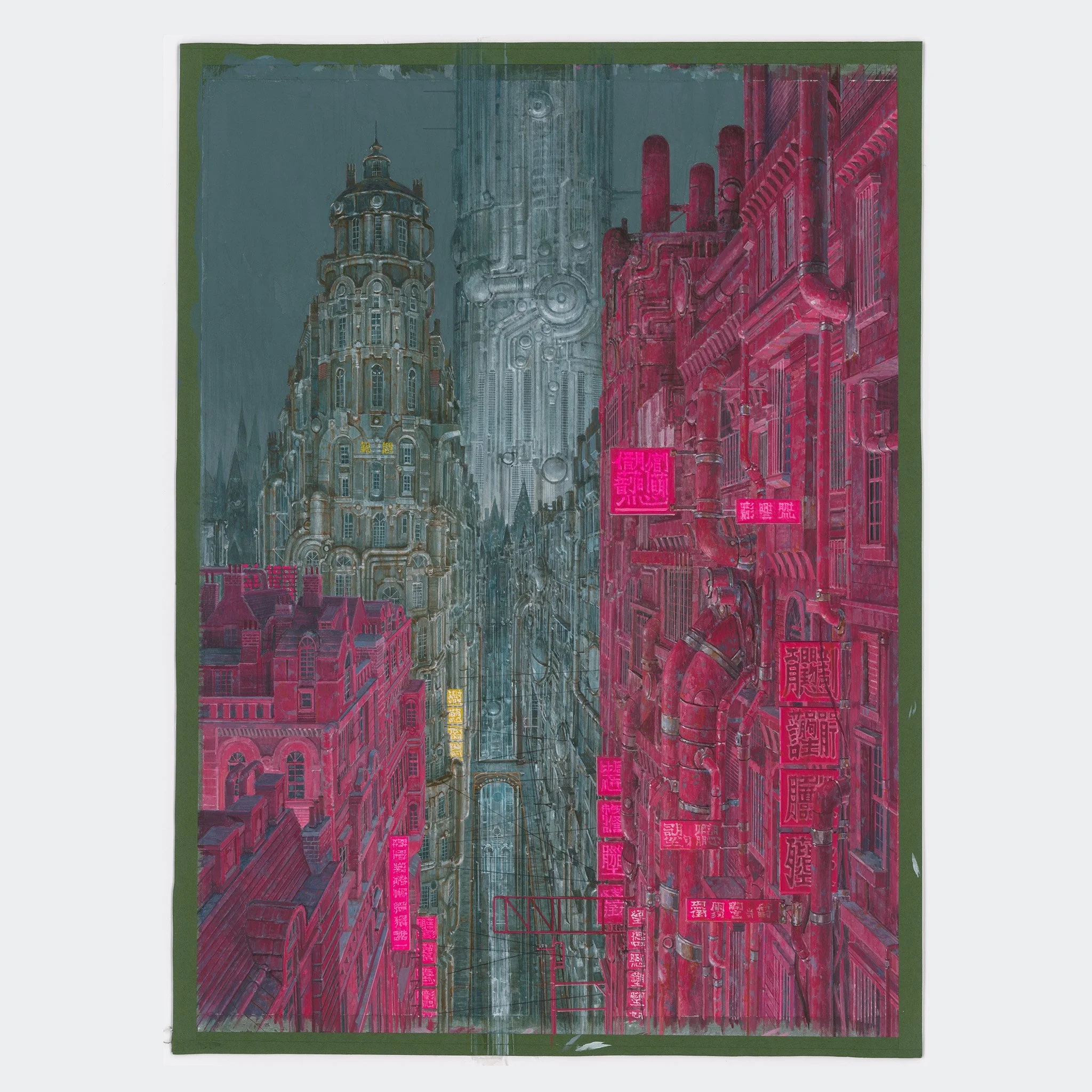

Shūichi Kusamori
Perdido Street Station, Scene No. 4
2024–2025
Solegraph (high-grade fine-art print)
Edition of 10 + 3 AP (artist proofs)
Numbered and signed by the artist
Format: 400 × 500 mm
Artwork Size: 405 × 308 mm
The four paintings in this series were created specifically for our exhibition Art for Animation: Shūichi Kusamori. They are inspired by China Miéville’s novel of the same name (Perdido Street Station, Macmillan, London, 2000).
In 2023, Stefan Riekeles spoke with the artist about the planned exhibition and suggested developing personal, self-initiated works to be shown alongside the commissioned pieces for anime. When asked about literary inspirations, Kusamori immediately named Miéville’s novel. The story is set in the fictional city of New Crobuzon—a dark, industrial place filled with fantastic creatures, magic, and machinery.
The depicted cityscapes are drawn from one of the book’s final chapters. They feature ornaments and small figures reminiscent of Kusamori’s drawings for Fuyu no O(Winter King) and his work on Metropolis. Over the years, the artist has developed his own visual language in which familiar forms, beings, and architectures reappear.